NCLEX Lab Values: The Complete List You Actually Need to Memorize
The NCLEX doesn't test every lab value in existence — it tests whether you can recognize when a value is dangerously off and what to do about it. This list covers the ranges that actually appear on the exam, grouped the way they're tested, with a memory hook for each group.
Electrolytes
| Lab | Normal range | Memory hook |
|---|---|---|
| Sodium (Na⁺) | 135–145 mEq/L | "135 to 145, keeps your brain alive" — think neuro changes when off |
| Potassium (K⁺) | 3.5–5.0 mEq/L | The heart value — outside this range, think ECG changes first |
| Chloride (Cl⁻) | 96–106 mEq/L | Follows sodium around; roughly Na minus 40 |
| Calcium (Ca²⁺) | 9.0–10.5 mg/dL | "9 to 10.5" — Trousseau's and Chvostek's signs when low |
| Magnesium (Mg²⁺) | 1.3–2.1 mEq/L | Low mag = tremors, torsades; high mag = absent reflexes |
| Phosphorus | 3.0–4.5 mg/dL | Inverse dance partner of calcium |
Glucose & renal
| Lab | Normal range | Memory hook |
|---|---|---|
| Glucose (fasting) | 70–100 mg/dL | Below 70 = treat the patient, not the number… but treat |
| HbA1c | <5.7% (goal <7% diabetic) | Three-month report card |
| BUN | 10–20 mg/dL | "10 to 20, kidneys plenty" — also rises with dehydration |
| Creatinine | 0.6–1.2 mg/dL | The true kidney number; doesn't budge for dehydration alone |
CBC
| Lab | Normal range | Memory hook |
|---|---|---|
| Hemoglobin (Hgb) | 12–16 g/dL (F), 14–18 g/dL (M) | Women 12–16, men add 2 |
| Hematocrit (Hct) | 37–47% (F), 42–52% (M) | Roughly Hgb × 3 |
| WBC | 5,000–10,000/mm³ | Below 5K: neutropenic precautions territory |
| Platelets | 150,000–400,000/mm³ | Below 150K = thrombocytopenia; below 50K = bleeding risk; below 20K = spontaneous bleeding |
Coagulation
| Lab | Normal range | Memory hook |
|---|---|---|
| INR | 0.8–1.1 (2–3 on warfarin) | Warfarin = INR — "War-far-INR" |
| aPTT | 30–40 sec (1.5–2× on heparin) | Heparin = aPTT — both have double letters |
| PT | 11–12.5 sec | Travels with INR |
ABGs
| Lab | Normal range | Memory hook |
|---|---|---|
| pH | 7.35–7.45 | Below 7.35 acidotic, above 7.45 alkalotic |
| PaCO₂ | 35–45 mm Hg | The respiratory number — CO₂ is an acid |
| HCO₃⁻ | 21–28 mEq/L | The metabolic number — bicarb is a base |
| PaO₂ | 80–100 mm Hg | Below 80 = hypoxemia |
| SaO₂ | 95–100% | Intervene trending below 95 (per patient baseline) |
Therapeutic drug levels
| Drug | Therapeutic range | Memory hook |
|---|---|---|
| Digoxin | 0.5–2.0 ng/mL | Toxicity: nausea, vision changes, bradycardia — check K⁺ too |
| Lithium | 0.5–1.2 mEq/L | Toxic >1.5 — tremor, confusion; watch sodium and hydration |
| Phenytoin | 10–20 mcg/mL | "10 to 20 keeps seizures empty" — gum hyperplasia at any level |
How to actually retain all of this
Reading a table once won't do it. Lab values stick through repeated, spaced exposure — seeing the numbers dozens of times over weeks, not cramming the night before. Two free ways to engineer that:
- Put them on your lock screen. We made a free NCLEX lab-values wallpaper that sits behind your iPhone clock, so the ranges are in front of you every time you check the time.
- Rotate them as widgets. The NurseLingo app includes a dedicated NCLEX Lab Values deck that rotates through these ranges on your lock screen all day.
Free download: the NCLEX lab-values lock-screen wallpaper — every range on this page, designed for iPhone.
Download the wallpaper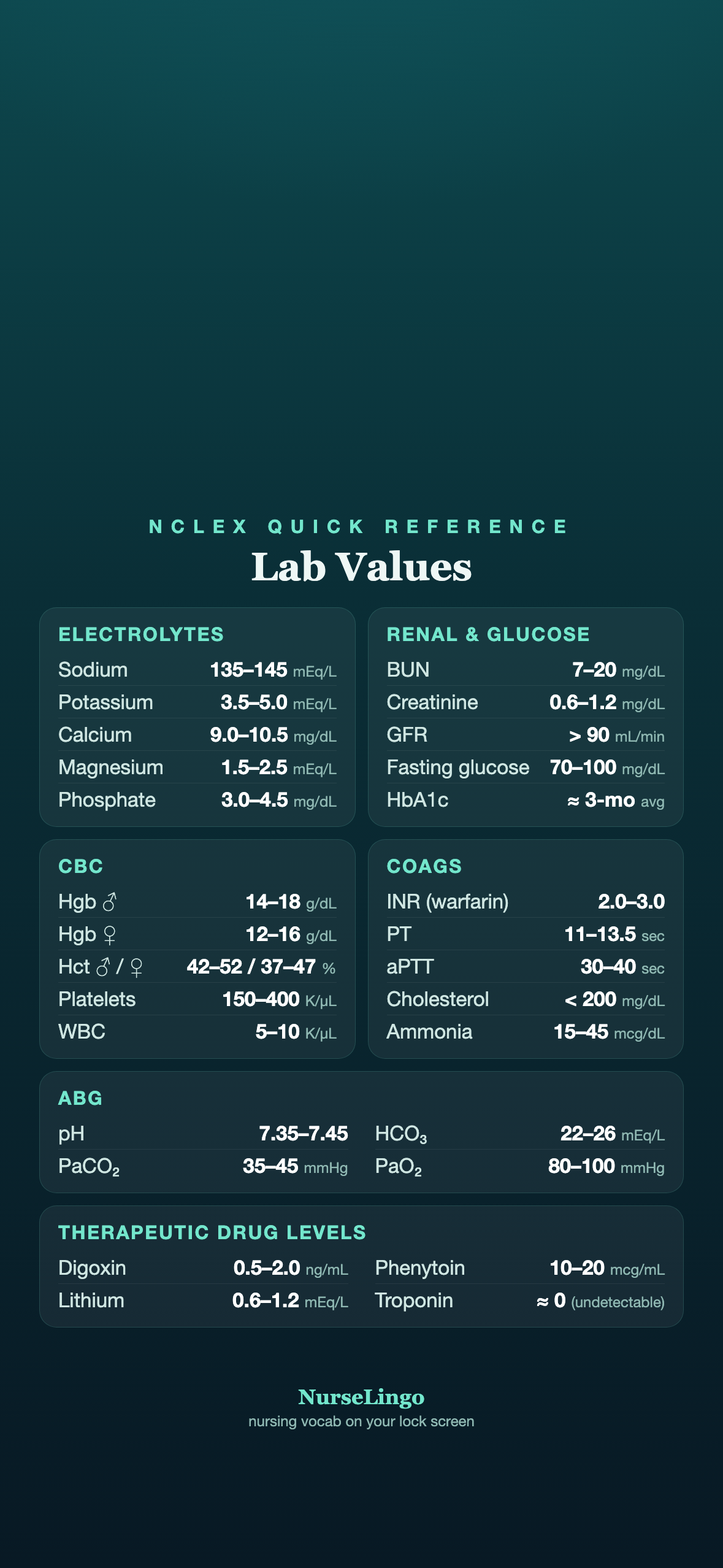
Normal reference ranges vary slightly by lab, textbook, and institution — always defer to your program's and facility's stated ranges. This guide is for exam study, not clinical decision-making.